
Espoir en commun
Prevent hate, break isolation and strengthen the power to act — through bilingual, human-centred spaces grounded in families’ realities.
Three ways in. One shared promise.
Espoir en commun brings prevention, peer support and navigation together so that people facing hate, caregivers and families affected by FASD can find an accessible first point of support in Ottawa.
The program centres listening, practical learning, peer connection and responsible links to community, psychosocial and institutional resources.
Choose the support that fits
Safer spaces against hate
A pathway serving Afro-descendant youth, women, volunteers and organizations across Ottawa–Gatineau.
- Bilingual community diagnostic
- Practical workshops and digital safety
- Sharing circles and peer support
- Listening, navigation and institutional prevention
Made possible with financial support from the Government of Canada through Canadian Heritage.
Gatherings for family caregivers
Recognition, connection and practical resources for people who support a family member, partner, friend or neighbour.
- Reduce isolation
- Value lived experience
- Access practical resources
With support from the Ontario Caregiver Organization.
UniFemmes–CCRCC Ottawa FASD support group
A culturally and linguistically responsive space for families and caregivers affected by fetal alcohol spectrum disorder.
- Peer support
- Information and guidance
- Stronger family networks
This project is funded through Partners for Planning.
A continuing cycle of meetings, listening and prevention
Espoir en commun is not a one-time event. Its public activities evolve with community needs while protecting the privacy of participants.
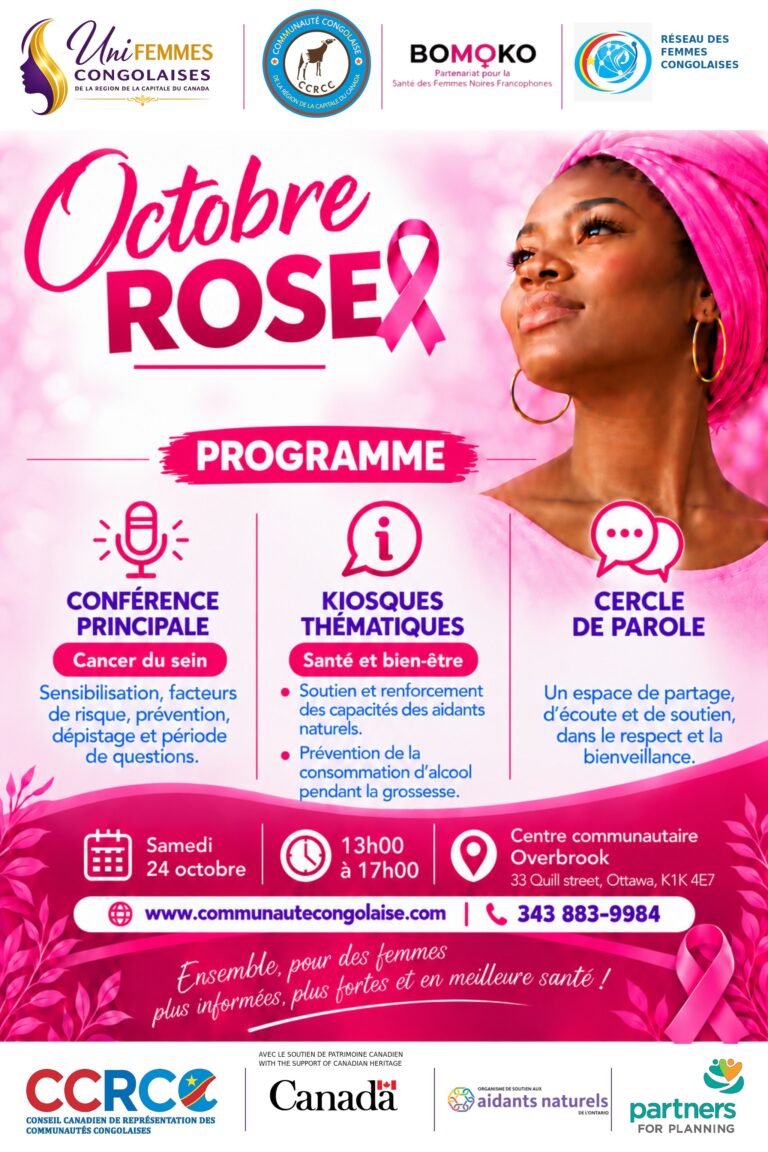
October Rose: information, prevention and mutual support
A public meeting at the Overbrook Community Centre featuring a breast-cancer awareness conference, health and well-being information booths, and a facilitated sharing circle.
- 33 Quill Street, Ottawa
- Led locally by UniFEMMES Congolaises
- With the support of Canadian Heritage

Five-minute bilingual community needs assessment
Adults in Ottawa–Gatineau can help identify barriers, training priorities and the most useful activity formats. Responses are reviewed only in aggregate.
Learn about the assessment →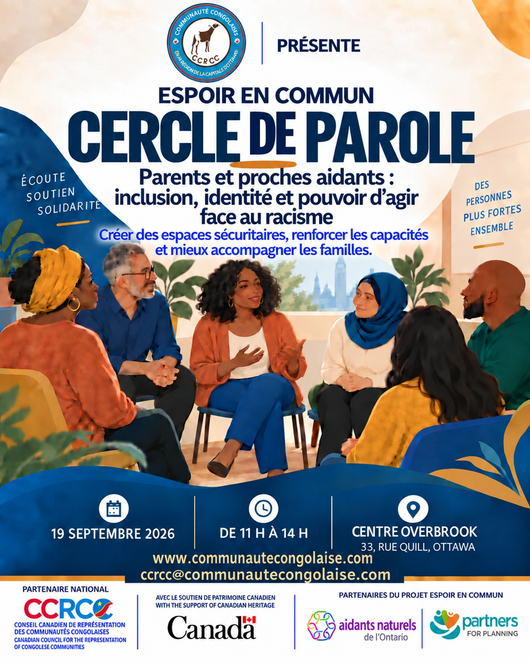
Sharing circle for parents and family caregivers
A respectful space on inclusion, identity and empowerment in the face of racism, designed for families, caregivers and community workers.
Read the institutional article (French) →Public information policy. This page presents program objectives, public notices and partner acknowledgements. Participant names, individual situations and confidential discussions are never published.
Bilingual community workshops
A 90-minute workshop every other Saturday, starting November 7, 2026, at 235 Donald Street in Ottawa. Registration is required and multiple dates may be selected.
Listening and referral line
Project launched in Ottawa and Gatineau. Call 343 996-4745 or email social@ottawa.communautecongolaise.com for non-urgent listening and referral.
Listen. Connect. Act.
Each pathway respects people’s pace and turns a request into a clear next step without requiring public disclosure.
A first conversation to understand the need and language preference.
A workshop, sharing circle, support group or referral to a partner resource.
Practical tools, useful connections and community continuity.
A dignified, safer space
- You may speak, write, observe or take a pause.
- You never have to share a personal experience.
- Conversations are guided with respect, care and confidentiality.
- Linguistic and cultural accessibility are part of the service.
A bridge, not an emergency service
Espoir en commun is not a police service, clinical assessment or legal consultation. The team facilitates community listening and navigation to appropriate resources.
For immediate danger, call 911. For a suicide crisis in Canada, call or text 988.
Partners who show up
Each identity below recognizes a distinct contribution to one of the program pathways.



This project is funded in part by the Government of Canada.
The family caregiver pathway receives support from the Ontario Caregiver Organization.
The FASD support group is funded through Partners for Planning.
You do not have to move forward alone.
Contact the Ottawa team to ask a question, propose a partnership or hear about upcoming activities.
Activities, schedules and participation criteria may evolve. The team will confirm the most appropriate pathway during the first conversation.